 ewsba.se
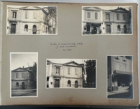
A page from one of the two photographic albums assembled by Gustave Coquiot after his May 1922 visit to Van Gogh sites in France
Van Gogh Academy, Auvers-sur-Oise (funded by Katie Sherborne). Photograph The Art Newspaper
Adventures with Van Gogh is a weekly blog by Martin Bailey, The Art Newspaper's long-standing correspondent and expert on the Dutch painter. Published on Fridays, stories range from newsy items about this most intriguing artist, to scholarly pieces based on meticulous investigations and discoveries.
Explore all of Martin’s adventures with Van Gogh here.
Two early photographic albums reveal many of the sites in France where Van Gogh painted, capturing places that were destroyed during the Second World War or by later modernisation. The images have been acquired by the recently established Van Gogh Academy, based in Auvers-sur-Oise, where they have just gone on display.
The photographs were taken by art critic Gustave Coquiot (1865-1926), who wrote one of the early biographies of the Dutchman, simply entitled Vincent van Gogh (1923). They are in albums interspersed with family photographs, mainly of Gustave’s wife Mauricia, a circus performer and feminist politician. Coquiot was famously painted by Pablo Picasso, who portrayed him with a troupe of scantily dressed dancers behind his head.
The albums have just been acquired for the Van Gogh Academy by its founder, Wouter van der Veen. In March 2023, a Paris auctioneer sold some Coquiot material, and Van der Veen later succeeded in contacting the vendor, who eventually agreed to sell further items, including the albums.
It is intriguing to compare Coquiot’s 1922 photographs of Arles with Van Gogh’s paintings 34 years earlier. They demonstrate how the artist was inspired by a landscape or subject, but would interpret them in a highly personal way.
Van Gogh’s The Yellow House (September 1888) and Coquiot’s photograph of the Yellow House (1922)
Van Gogh Museum, Amsterdam (Vincent van Gogh Foundation) and Van Gogh Academy, Auvers
Coquiot’s view of the Yellow House, where Van Gogh lived for much of his time in Arles in 1888-89, suggests that it had become a shabby building by the early 1920s. Barely visible in the photograph is a notice reading "Chambres meublées à louer" (Furnished rooms to rent), just to the right of the front door.
It had been many years earlier that Van Gogh arranged for its exterior to be painted a cheery yellow. The artist then had his studio at the front of the ground floor, with the kitchen behind. Van Gogh’s bedroom was on the left side of the upper floor and fellow painter Paul Gauguin’s room was on the right. The Yellow House was severely damaged by Allied bombs in 1944 and then demolished. Coquiot’s photographs therefore provide valuable evidence about its original exterior.
Van Gogh’s View of Arles on the River Rhône (May 1888) and Coquiot’s photograph of the Rhône (1922)
Boijmans van Beuningen Museum, Rotterdam and Van Gogh Academy, Auvers
Just a few minutes’ walk away, across Place Lamartine, lies the River Rhône. It was from its bank that Van Gogh drew View of Arles on the River Rhône (May 1888), facing south, looking towards the centre of town. The view today remains relatively unchanged, with mainly low-rise buildings.
Van Gogh’s The Drawbridge (May 1888) and Coquiot’s photograph of the Langlois Bridge (1922)
Wallraf Richartz Museum & Fondation Corboud, Cologne and Van Gogh Academy, Auvers
One of Van Gogh’s favourite landscape motifs on the outskirts of Arles was the Langlois Bridge over the canal which runs to the Mediterranean. This drawbridge may well have reminded him of his native Netherlands. The Langlois Bridge was rebuilt around 1930; this replacement was blown up by retreating German forces in 1944.
Jules Armand’s Seated Arlesienne (1889) and Coquiot’s photograph of the Lion drug shop (1922)
© Cd13, Museon Arlaten-Musée de Provence, Arles and Van Gogh Academy, Auvers
The pharmacist and grocer Jules Armand, who sold artists’ supplies to Van Gogh, had his shop at 30 Rue du 4 Septembre, in the centre of Arles. In March 1888, a week after Vincent’s arrival in Arles, he told his brother Theo that he had been visited by “two amateur painters, one of whom is a grocer — and also sells painting materials”. Armand’s Seated Arlesienne (1889), which may have been painted while Van Gogh was still in town, suggests that he was considerably more talented than a mere amateur. Armand sometimes displayed paintings in his shop window, so one wonders whether he ever showed Van Gogh’s work.
Coquiot’s photograph of the shop was taken well after Armand’s death in 1909, but the window still bore the wording “peinture artistique” (artists' materials). Coquiot met Armand's widow Joséphine, who told him that Van Gogh had been “a very original man” but suspicious, and had not wanted to show his paintings to her husband. The building which had housed the Armand shop was also bombed in 1944.
Van Gogh’s Tarascon Stagecoach (October 1888) and Coquiot’s photograph of a stagecoach in Arles (1922)
Los Angeles County Museum of Art (gift of Henry and Rose Pearlman Foundation) and Van Gogh Academy, Auvers
Van Gogh had painted a stagecoach, which served the town of Tarascon, 20km to the north of Arles. Although such horse-drawn carriages were much less common by the 1920s, Coquiot came across one during his visit to Arles.
Van Gogh’s Fishing Boats on the Beach at Les Saintes-Maries-de-la-Mer (June 1888) and Coquiot’s photograph of fishing boats lined up on the same beach (1922)
In the first week of June 1888, Van Gogh visited the Mediterranean for the first time, going to the fishing village of Saintes-Maries-de-la-Mer. He made the 40km journey by stagecoach. There he painted a seascape with colourful boats on the beach. Coquiot photographed a similar scene.
Van Gogh’s The Courtyard of the Hospital at Arles (April-May 1889) and Coquiot’s photograph of the courtyard garden (1922)
Oskar Reinhart Collection “Am Römerholz”, Winterthur and Van Gogh Academy, Auvers
In the evening of 23 December 1888, Van Gogh suffered a mental crisis and cut off most of his left ear. The following morning he was taken to the hospital of Arles, where he stayed for much of the time until his departure for the asylum at Saint-Rémy-de-Provence in May 1889.
At the Arles hospital he enjoyed the courtyard garden beneath the male ward, and once painted the scene. The courtyard was much the same by the time of Coquiot’s visit. In 1986, the hospital was closed and converted into a médiathèque. The courtyard was then replanted to make it appear as in Van Gogh’s painting.
Van Gogh’s Portrait of Dr Félix Rey (January 1889) and Coquiot’s photograph of Dr Rey (1922)
Pushkin State Museum of Fine Arts, Moscow and Van Gogh Academy, Auvers
The doctor who treated Van Gogh was the young intern Félix Rey, who would be immortalised in a portrait. When Coquiot met him over three decades later, Dr Rey had risen to run the medical services of Arles. The doctor showed him around the hospital and the courtyard garden. Coquiot recalled: “Of all those I saw in Arles who had known Vincent, it was Doctor Rey who had the most vivid memories.”
Exhibition of photographs by Coquiot, Van Gogh Academy, Auvers
The display of Coquiot’s photographs is presented at the Van Gogh Academy, at 1 Rue François Mitterrand, Auvers-sur-Oise (open Fridays and Saturdays, 2pm-6pm, until 20 June).
Martin Bailey is a leading Van Gogh specialist and special correspondent for The Art Newspaper. He has curated exhibitions at the Barbican Art Gallery, Compton Verney/National Gallery of Scotland and Tate Britain.
Martin has written a number of bestselling books on Van Gogh’s years in France: The Sunflowers Are Mine: The Story of Van Gogh's Masterpiece (Frances Lincoln 2013, UK and US), Studio of the South: Van Gogh in Provence (Frances Lincoln 2016, UK and US), Starry Night: Van Gogh at the Asylum (White Lion Publishing 2018, UK and US) and Van Gogh’s Finale: Auvers and the Artist’s Rise to Fame (Frances Lincoln 2021, UK and US). The Sunflowers are Mine (2024, UK and US) and Van Gogh’s Finale (2024, UK and US) are also now available in a more compact paperback format.
His other recent books include Living with Vincent van Gogh: The Homes & Landscapes that shaped the Artist (White Lion Publishing 2019, UK and US), which provides an overview of the artist’s life. The Illustrated Provence Letters of Van Gogh has been reissued (Batsford 2021, UK and US). My Friend Van Gogh/Emile Bernard provides the first English translation of Bernard’s writings on Van Gogh (David Zwirner Books 2023, UKand US).
To contact Martin Bailey, please email vangogh@theartnewspaper.com
Please note that he does not undertake authentications.
Explore all of Martin’s adventures with Van Gogh here